Richard Jordan Gatling's Invention
The weapon that Custer refused traced its origin to a North Carolina inventor and a grief shared with thousands of Civil War families. Richard Jordan Gatling, a physician and mechanical engineer born in Hertford County in 1818, patented his rapid-fire gun on November 4, 1862. He later explained his motive in almost utopian terms: if one man could do the work of a hundred with a single machine, the armies of the world might be reduced, and the slaughter of young soldiers diminished. History took his invention in the opposite direction.
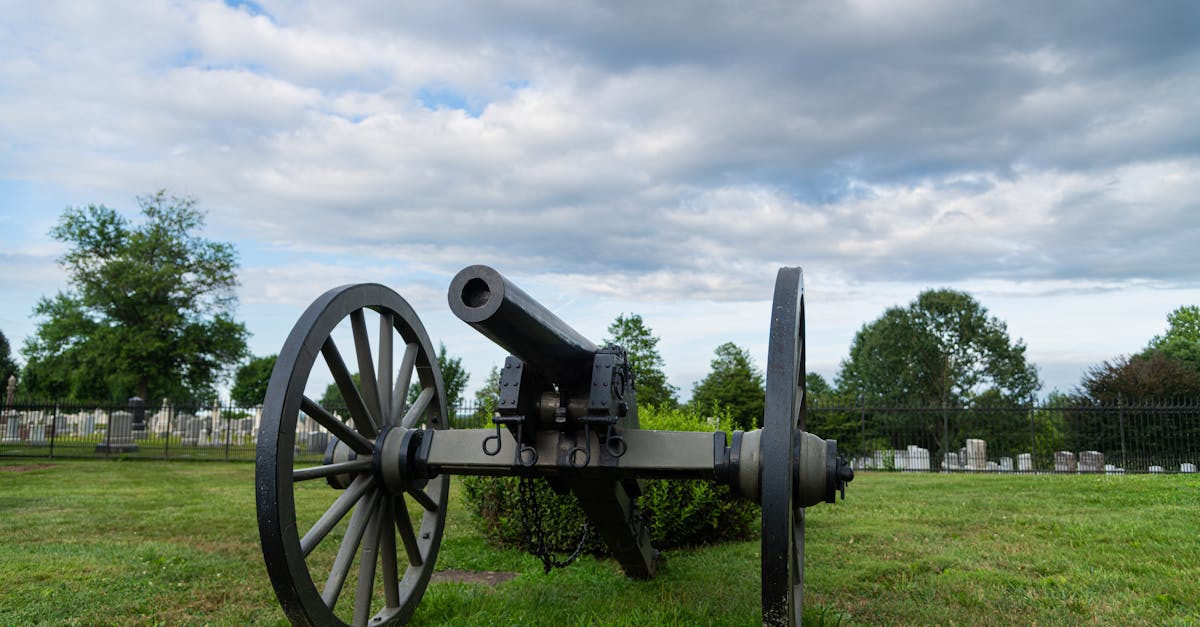
The mechanism was deceptively simple. A cluster of six — later ten — rifled barrels revolved around a central axis, driven by a hand crank. Each barrel carried its own breech and firing pin. As the operator turned the crank, cartridges fed down from an overhead hopper or Broadwell drum, each barrel loading, firing, and ejecting in sequence. Rates of fire reached 350 rounds per minute in the early models and more than 600 in later variants — an unthinkable volume of fire at a time when the standard infantry rifle fired two or three aimed rounds in the same span.
The U.S. Army formally adopted the Gatling in 1866, after the Civil War's conclusion. The 1866 model in .50 caliber, followed by improvements in 1871, 1874, and the landmark 1876 Colt- manufactured version, became the Army's standard crew-served heavy weapon through the Indian Wars and into the Spanish-American War of 1898, when Lieutenant John H. Parker's Gatling detachment proved decisive at the Battle of San Juan Heights.
The 1876 Colt Gatling at a Glance
- Inventor: Richard Jordan Gatling (patented November 4, 1862)
- Manufacturer: Colt's Patent Fire Arms Manufacturing Company, Hartford, Connecticut
- Caliber: .45-70 Government
- Barrel Cluster: Ten rifled steel barrels
- Breech: Brass, engraved with Colt and Gatling patent markings
- Furniture: Oil-finished American walnut carriage
- Rate of Fire: Approximately 350 rounds per minute sustained
- Adoption: U.S. Army standard, 1866–1911
Terry's Offer, Custer's Refusal
The Dakota Column of Brigadier General Alfred H. Terry marched out of Fort Abraham Lincoln in May 1876 as part of a three-pronged campaign against the non-treaty Lakota and Northern Cheyenne bands that had gathered under Sitting Bull of the Hunkpapa Lakota and Crazy Horse of the Oglala. Terry's command included the 7th Cavalry under Custer, elements of the 17th and 20th Infantry, and Lieutenant Low's platoon of three Gatling guns from the 20th Infantry.
At the conference aboard the steamer Far West at the mouth of the Rosebud on the evening of June 21, Terry offered Custer both the Gatling detachment and four additional companies of the 2nd Cavalry under Major Brisbin. Custer refused both. His reasoning, as later reconstructed from the recollections of officers present, rested on mobility. The Gatlings, mounted on condemned cavalry carriages drawn by four horses each, had bogged down repeatedly on the march up the Yellowstone. Custer believed they would slow his column and compromise the element of surprise on which his plan depended.
“The Gatlings might hamper our movements or might not be able to keep up. The 7th Cavalry can handle anything it meets.”
There is a bitter irony in the judgment. The terrain along Reno Creek and down into the Little Bighorn valley was indeed rough, but it was no worse than country the Gatlings had already crossed. More consequentially, Custer had overestimated the mobility of his own command and radically underestimated the size of the village he was about to attack — perhaps 1,800 to 2,000 warriors, the largest concentration of Plains Indian fighting men assembled in the nineteenth century.
June 25, 1876: The Little Bighorn
Custer divided the 7th Cavalry into three battalions early on the afternoon of June 25. Captain Frederick Benteen was sent south with three companies to scout the upper valley. Major Marcus Reno crossed the Little Bighorn with three companies and attacked the southern end of the village. Custer, with five companies — C, E, F, I, and L — moved north along the bluffs to strike the village's flank.
Reno's attack stalled under ferocious resistance, disintegrated into a disordered retreat back across the river, and left him pinned on the bluffs that now bear his name. Custer's battalion, moving to strike the village from the north, was enveloped by warriors under Crazy Horse, Gall, and Two Moon. Within perhaps forty minutes, every man with Custer — some 210 soldiers, scouts, and civilians — was dead.
Reno and Benteen, reunited on the bluffs, held out for another day and a half. Lieutenant Low's Gatlings, still with the infantry column, were too far south to intervene. Terry's relief force reached the battlefield on the morning of June 27. The burial parties' accounts of what they found passed quickly into the national memory.
What the Gatlings Might Have Done
The counterfactual is one of the most debated in American military history. Three Gatlings firing .45-70 rounds at 350 rounds per minute apiece would have represented, at most, a momentary suppressive weight of fire on a fixed line. They could not have saved the isolated Custer battalion, which was overrun in open rolling country where crew-served weapons would have had limited fields of fire. They might, however, have allowed Reno's command to hold the timber at the southern end of the village, changing the shape of the engagement entirely. General Nelson A. Miles, writing years later, was unambiguous: Custer's refusal of the guns was, in his judgment, a decisive error.
“Three Gatlings and four companies of the 2nd Cavalry — the offer Custer refused at the mouth of the Rosebud.”
The Doctrine That Followed
The Little Bighorn did not end Plains warfare — the Nez Perce campaign of 1877, the Bannock War of 1878, and the final pursuit of the Apache under Geronimo into 1886 all lay ahead — but it did reshape the Army's thinking about the role of machine weapons in frontier operations. Gatling detachments accompanied every major column thereafter. By the time the Ghost Dance crisis reached Wounded Knee in December 1890, four Hotchkiss guns, the Gatling's lighter cousin, were part of the 7th Cavalry's order of battle.
Twenty-two years after the Little Bighorn, at the top of San Juan Heights in Cuba, the Gatling finally received the demonstration its designer had envisioned. Lieutenant Parker's battery, firing from close range into Spanish trench lines, broke the defense and opened the way for Theodore Roosevelt's Rough Riders. Roosevelt later wrote that the sound of Parker's guns — a distinctive mechanical grinding pulse — was one of the most welcome noises of his life.
Gary Hendershott and the Gatling Record
Over five decades in the field, Gary Hendershott has handled multiple pieces that stand at the center of this history. These include the 1871 model in its transitional configuration, the 1876 Colt Gatling of the exact pattern Custer refused, and the 1883 Colt-manufactured Gatling with its Broadwell drum feed. Each weapon carries the patent markings, serial ranges, and manufacturing provenance that allow a definitive attribution to a specific Army arsenal or cavalry regiment.
Authentication of a Gatling gun requires examination of the breech markings, serial number consistency across the receiver and barrel cluster, carriage ironwork, and the integrity of the feed mechanism. Reproductions and composite assemblies are not uncommon; original 1876-pattern Colt Gatlings in original configuration are vanishingly rare on the private market. Gary's approach to provenance and authentication draws on decades of work with documented Indian Wars material.
Why the 1876 Gatling Still Matters
As an artifact of American firearms history, the 1876 Colt Gatling is a hinge point. It sits at the boundary between Civil War ordnance, which it technically predates, and the modern machine gun that Hiram Maxim would patent only a decade later. More importantly, it is the weapon whose absence defined the most famous defeat of the American West. To handle an 1876 Gatling is to hold the instrument of a choice Custer made on the evening of June 21, and the consequence that followed on the twenty-fifth.