
The King Who Became a God
Alexander III of Macedon was born in Pella in July of 356 BC, son of Philip II and Olympias of Epirus. He ascended the throne at twenty after his father's assassination in 336 BC and within two years had crossed the Hellespont at the head of a combined Macedonian and Greek army. The Battle of the Granicus in 334 BC broke the western satrapies of the Achaemenid Persian Empire. Issus in 333 BC broke the Great King's field army. Gaugamela in 331 BC broke the empire itself.
Between those campaigns, in the winter of 332–331 BC, Alexander entered Egypt. The Persian satrap surrendered without a fight. Alexander was crowned Pharaoh at Memphis, consulted the oracle of Amun at Siwa in the Western Desert — where the priests reportedly addressed him as the son of the god — and, returning to the coast, marked out the foundation of Alexandria at the mouth of the western Nile. It would become, within a century of his death, the intellectual capital of the Mediterranean world.
His march into Bactria, Sogdiana, and the Punjab between 329 and 325 BC carried Greek arms farther east than any European army would travel for more than two millennia. He returned to Babylon in 323 BC, fell ill in early June, and died on the tenth or eleventh of that month. His body, embalmed by Egyptian and Chaldean methods, was redirected by his general Ptolemy to Memphis and then to Alexandria, where it rested in the Sema mausoleum for more than six centuries, visited by Julius Caesar, Augustus, and Caracalla.
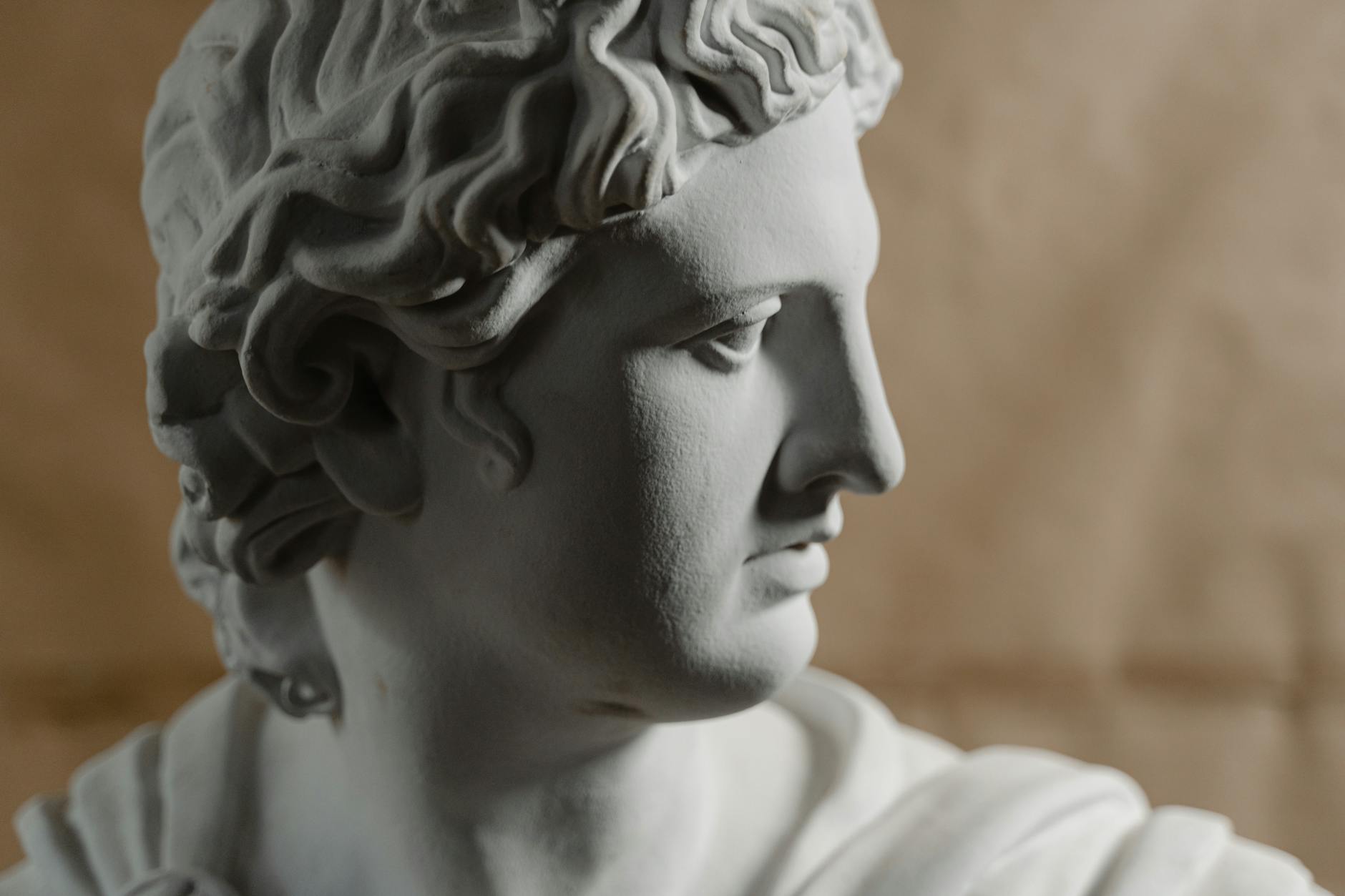
The Portrait Head at a Glance
- Subject: Alexander the Great (356–323 BC)
- Period: Ptolemaic, Graeco-Egyptian, 3rd century BC
- Likely Origin: Alexandria or a Ptolemaic workshop in Lower Egypt
- Medium: White marble, likely Parian or Pentelic
- Iconographic Type: Lysippan, with anastole hair and upward gaze
- Comparanda: Azara Herm (Louvre Ma 436); Acropolis Alexander (Athens); coin portraits by Lysimachus, 305–281 BC
The Ptolemaic Dynasty and the Cult of Alexander
When Alexander died without a clear successor, his generals — the Diadochi — divided the empire in a series of wars that ran from 323 to roughly 280 BC. Ptolemy son of Lagos, one of Alexander's closest companions and a member of the royal bodyguard, took Egypt as his satrapy in 323 BC and declared himself king as Ptolemy I Soter (“the Saviour”) in 305 BC. His dynasty would rule Egypt for just under three hundred years, from Alexandria, until the suicide of Cleopatra VII in August of 30 BC brought the line to an end and Egypt into the Roman imperial system.
The Ptolemies built their legitimacy on Alexander. They displayed his mummified body in a crystal sarcophagus at the heart of their capital. They struck coins bearing his portrait for more than a century after his death. They commissioned sculpted images of him in bronze, marble, and gemstone for temples, for the royal palaces, and for distribution to client cities across the eastern Mediterranean. The Graeco-Egyptian portrait head examined here emerges from precisely this cultural program — an object made in Alexandria or a closely related workshop, within perhaps a hundred years of the conqueror's death, by sculptors working in the Greek tradition for a Ptolemaic patron.
“No ancient ruler was imitated in art so widely, for so long, as Alexander. The turn of the head, the lift of the eyes, the flare of the hair at the forehead — once fixed, these never left the European imagination.”
The Iconography: Lysippos and the Anastole
The canonical image of Alexander was established in his lifetime by the court sculptor Lysippos of Sicyon, one of the three great Greek sculptors of the late classical period alongside Praxiteles and Scopas. Ancient sources — Plutarch's Life of Alexander and Pliny the Elder's Natural History — record that Alexander forbade any artist other than Lysippos to sculpt him, Apelles to paint him, and Pyrgoteles to cut his image on gems. Whether the prohibition was absolute or merely a reflection of court preference, the result was the same: a single, highly codified iconographic type.
That type has several defining features. First, the anastole: the characteristic upward flare of hair from the forehead, rising to a central parting and falling back in deep lion-like locks. Ancient writers explicitly compared this hair to the mane of a lion, and through it to Heracles, from whom the Argead royal house claimed descent. Second, the slight tilt and upward turn of the head, often accompanied by a raised gaze — a pose the ancient sources associated with Alexander's characteristic pothos, the longing for what lies beyond. Third, the strongly modeled brow, the deeply set eyes under heavy lids, and the slightly parted lips that give later Hellenistic Alexanders a quality of emotional charge absent from classical royal portraiture.
Authenticating an Alexander Portrait
Scholars authenticate sculpted portraits of Alexander through a tightly defined chain of comparanda. The Azara Herm in the Louvre (inventory Ma 436), a Roman copy of a Greek original inscribed with Alexander's name, provides the anchor. The so-called Acropolis Alexander, excavated in Athens in the nineteenth century, offers a contemporary or near- contemporary comparison. Coin portraits, particularly the tetradrachms struck by Lysimachus of Thrace between roughly 305 and 281 BC — showing Alexander with the horn of Zeus Ammon emerging from his temple — provide a precisely dated numismatic control.
Beyond the iconographic comparison, authentication proceeds through examination of the marble itself (Parian lychnites and Pentelic marbles have distinct crystallography and trace element profiles), the carving technique (claw-chisel patterns, drilled locks, polished versus left-roughened surfaces consistent with Hellenistic workshop practice), surface patination, and any archaeological or collection history that can establish the object's trajectory through the modern market. A Ptolemaic-period Alexander is a specialist's object — its appearance, its provenance, and its condition must all survive the scrutiny of curators at institutions such as the Getty, the Metropolitan Museum, and the Ny Carlsberg Glyptotek in Copenhagen.
“He was the face every Hellenistic king wished to borrow — the lion-maned conqueror, still thirty-two forever.”
The Afterlife of an Image
Alexander's portrait was the most imitated in antiquity. Every successor king borrowed elements of his iconography — the upward gaze, the diadem, the flowing hair. Roman generals from Pompey the Great, who affected Alexander's hairstyle, to Caracalla, who visited the Sema in Alexandria in AD 215 and had himself portrayed in imitation, measured themselves against the Macedonian. The type passed through Byzantine manuscript illumination, Islamic metalwork, and Renaissance medallic art. It is arguably the most continuously reproduced portrait in Western history after that of Christ.
To hold an original Ptolemaic-period Alexander in one's hands, then, is to touch a node in that chain. It is an object made by Greek sculptors working in Egypt, under a dynasty founded by one of the conqueror's own generals, within living memory of men who had marched with him to India.
Gary Hendershott and the Ancient Portrait Tradition
Over five decades in the field, Gary Hendershott has handled a broad range of ancient Mediterranean material, including Ptolemaic and Roman period portraits of Alexander in marble and bronze, as well as the numismatic and gem-cut comparanda by which such objects are authenticated. The authentication of an ancient portrait requires stylistic analysis, physical examination of the stone and tool marks, and continuous collection history — a provenance research process that can take months of archival work to resolve.
Why This Portrait Matters
An Alexander head of the Ptolemaic period is not simply a beautiful object. It is a direct material link to the historical moment in which Greek culture, Egyptian religion, and Macedonian political power fused into the Hellenistic world that shaped the Mediterranean until the Arab conquest of the seventh century AD. For institutions, it anchors a classical collection. For serious collectors, it is among the small number of objects that still carry the weight of that history in stone.